



UK jobs market August 2026: GDP is growing – so why is hiring still so tough?
Table of Contents
- Great GDP figures offer some relief
- But jobs are still being lost
- Vacancies fall, unemployment holds
- What does this mean for recruiters?

Hiring trends update spring 2026
DownloadEach month, Julius Probst, our Senior Economist at The Stepstone Group, breaks down the latest ONS Labour Market Overview for recruiters across the UK. You can also watch him walk through the data on Recruitonomics, the monthly video update from our partners at Appcast.
GDP is up, inflation is easing, and the Bank of England has room to cut rates. So why does hiring still feel so hard?
The UK labour market is still shedding jobs despite a solid GDP report earlier this month, where growth surprised on the upside. The job losses remain concentrated in retail and hospitality; two industries with little exposure to artificial intelligence.
A challenging business environment and subdued consumer spending are weighing on both sectors. The Burnham government will need to turn this around as quickly as possible.
Speculation about the next Labour Budget, scheduled for 28 October, is not exactly helping. Whichever direction it takes, the priority will be avoiding measures that add further pressure to an already softening jobs market.
The short answer to the question above: GDP growth and job creation have decoupled. The economy is becoming more productive, but that productivity is not yet translating into new roles. For recruiters, that means the challenge right now is less about generating candidate interest and more about hiring well under continued uncertainty.
Great GDP figures offer some relief
GDP figures offered some relief earlier this month as the UK economy beat expectations by a wide margin. Growth came in at an annualised rate of 2.5% in the first quarter and 1.7% in the second quarter of this year.
Economists expect that the negative effects from the oil price shock will materialise in the coming months as household energy bills continue to rise. Both businesses and consumers are likely to be cautious with their spending decisions in the weeks ahead as they await the Budget.
The recurrent growth drag after summer in recent years has been due to a combination of bad luck and questionable policymaking, not any underlying structural weakness in the UK economy.
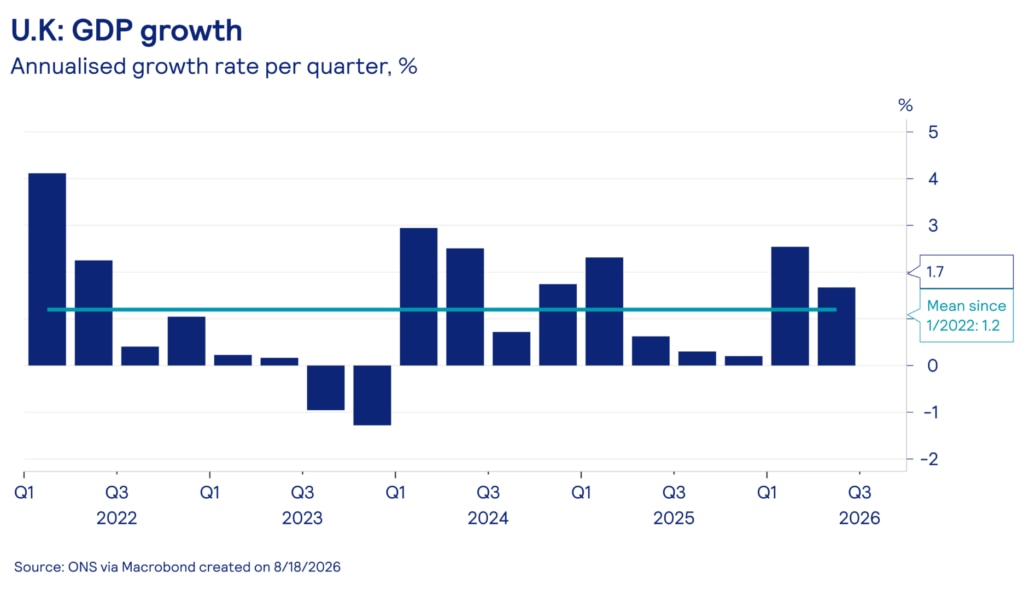
So the economy is growing. The trouble is, the jobs market hasn’t got that memo yet.
But the labour market continues to shed jobs
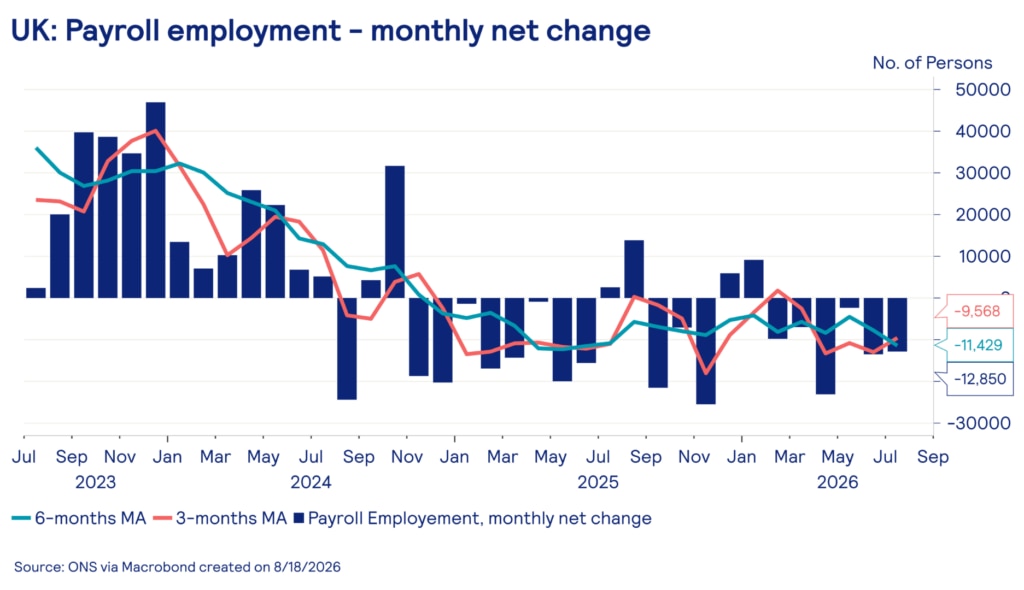
July’s jobs numbers show that close to 13,000 jobs have been lost, while the June figures were revised down to show a similar decline. This brings cumulative job losses since autumn 2024 to around 190,000.
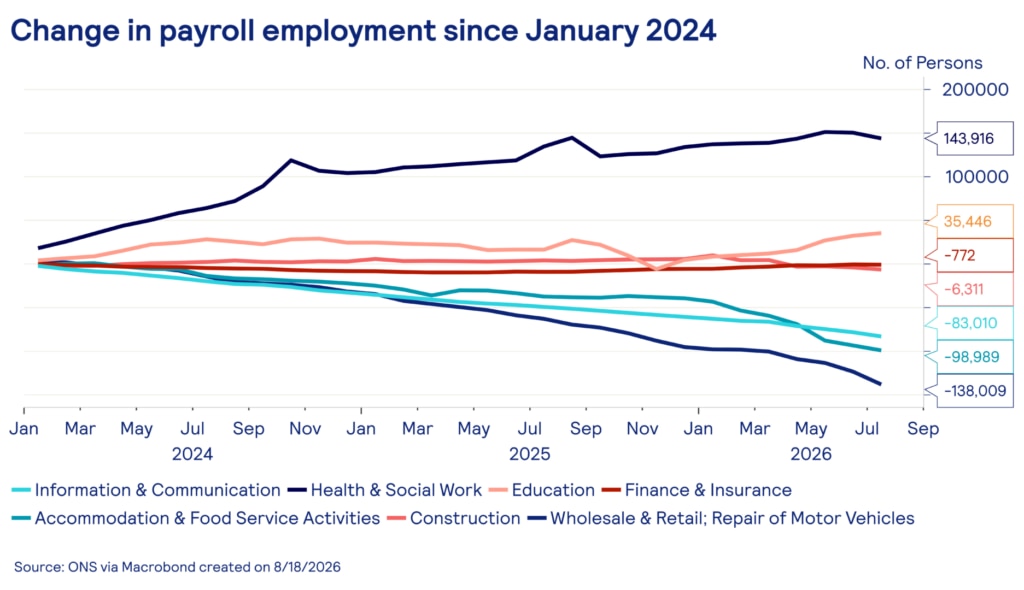
The sectoral picture remains unchanged. Retail is down by around 140,000 since January 2024 and hospitality by 100,000. Most other industries are broadly stagnant.
The exception is the tech sector (information and communication), which has lost around 83,000 jobs over the same period. Healthcare remains the standout bright spot: the biggest source of job creation in the UK, adding around 145,000 jobs over the last two and a half years.
The picture at a sector level matters for recruiters, because where jobs are being lost tells you where available talent is coming from, and where the competition for candidates remains intense. Totaljobs’ recent Hiring Trends Update, backs this up: A third (32%) of recruiters cite finding candidates with the right skills as the #1 hiring barrier right now, while meeting salary expectations (23%) and flexible working demands (17%) follow close behind. The macro picture and the on-the-ground experience are telling the same story.
Labour demand is falling as unemployment holds steady
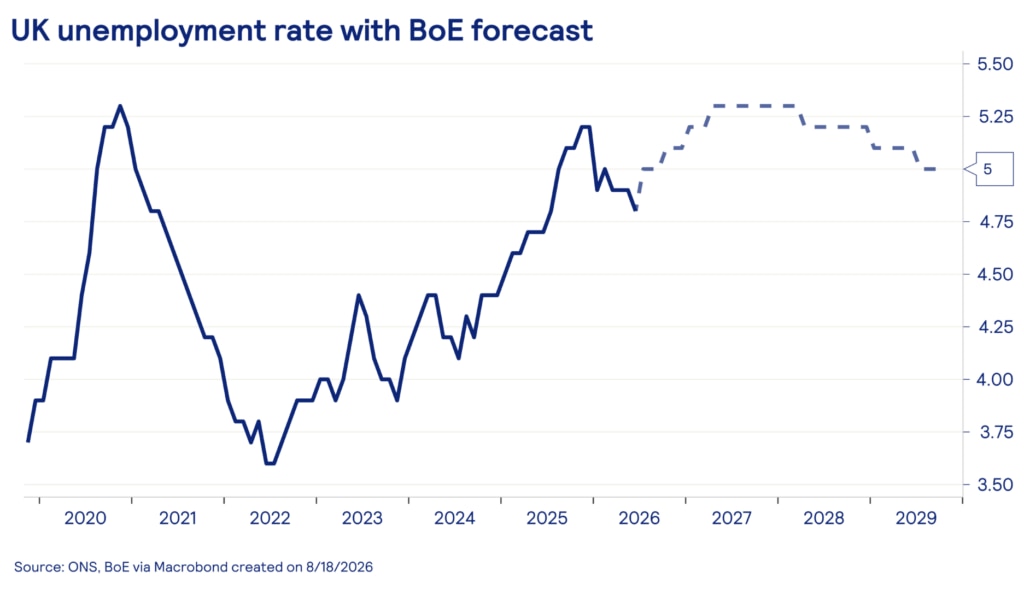
The unemployment rate remains steady at 4.9%, defying the more pessimistic forecast from the Bank of England for now. While the Bank projects a gradual rise to 5.3% by year end, it now looks more likely that unemployment will hover around 5% for the time being.
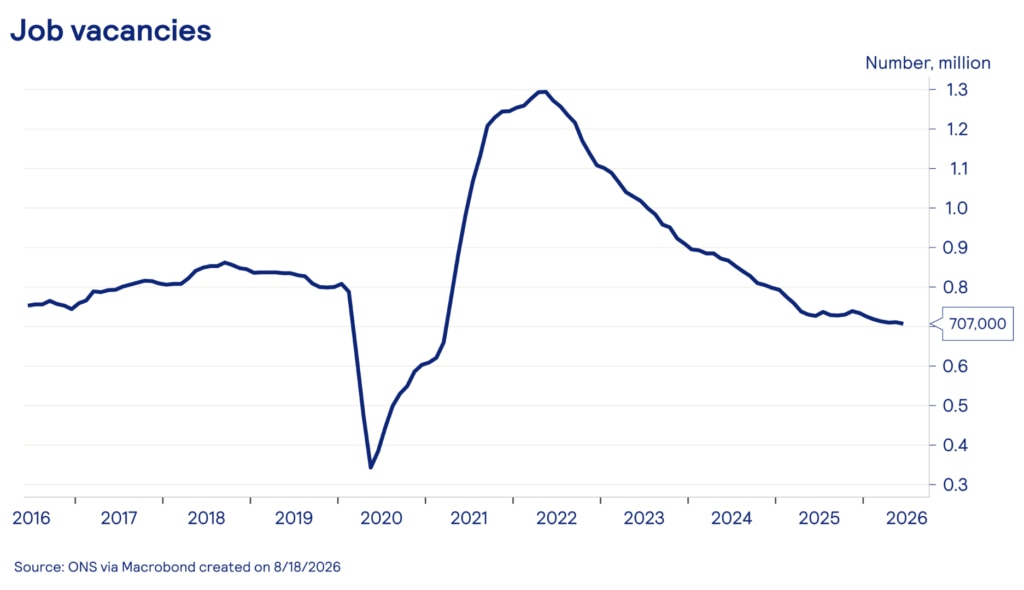
Meanwhile, labour demand is still falling as employers dial back recruitment. Total UK vacancies fell to 707,000, the lowest figure since 2015. Worker churn (the flow of people moving between jobs) has come to a near standstill. Companies are pulling back on hiring and workers are less able to switch roles.
For jobseekers, conditions remain tough. The lack of labour market dynamism will carry longer-term economic costs if we do not see an uptick before long.
That caution among workers shows up clearly in Totaljobs research too. Only 18% of UK workers are actively looking for a new job right now. A further 66% are open to the right offer but not actively searching – what we’d describe as passively available. And half (51%) say recent redundancies have made them feel less secure, which goes some way to explaining why so many are sitting tight rather than moving. The talent is there; reaching it requires a different approach than posting and waiting.
Within that overall picture, one group is bearing a disproportionate share of the pressure.
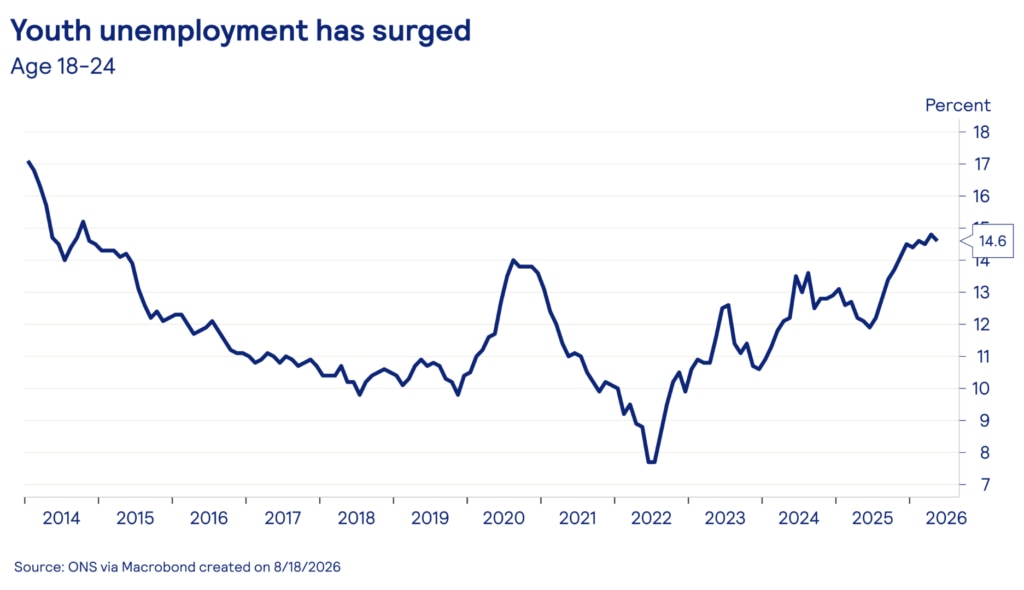
Young workers are feeling it most acutely. The employer National Insurance increase and minimum wage rise under Labour have pushed up employment costs significantly. Retail and hospitality have responded by cutting the part-time and summer roles that have historically provided entry points for younger people.
Youth unemployment has risen to around 14.6%, its highest level since the years following the Global Financial Crisis. The broader shift towards remote work since the pandemic and accelerating AI adoption are two additional headwinds for graduates entering the market. For employers who have historically relied on seasonal or part-time young workers, this signals that the talent pool exists but the entry-level infrastructure to reach them has thinned considerably.
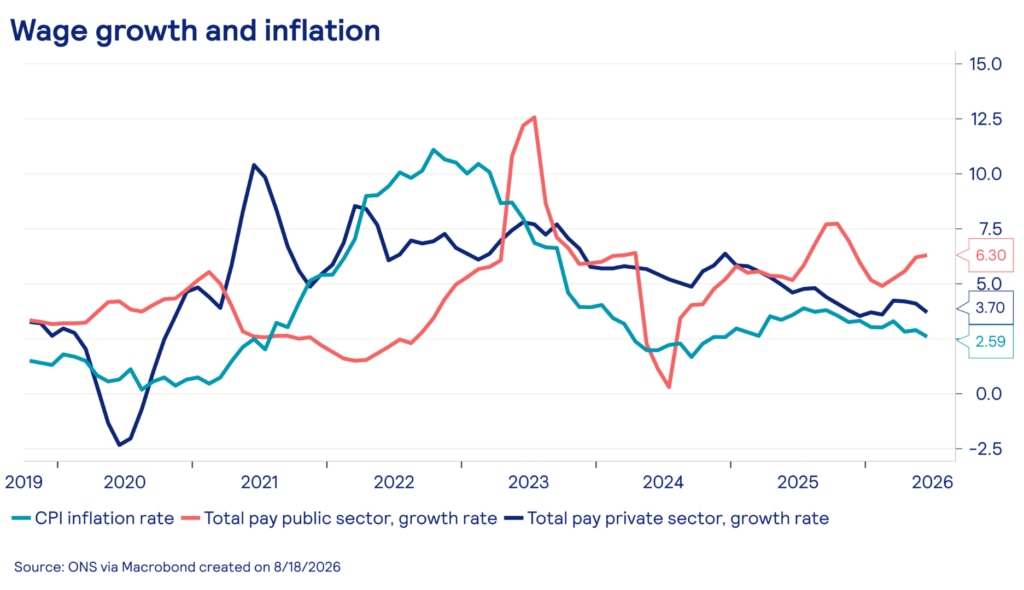
Wage growth continues to moderate, reflecting the softer labour market. There is a notable divide between private and public sector pay, with the latter outperforming by around 2.5 percentage points. For the Bank of England, easing wage pressures are a welcome development, allowing for a more measured response to the oil price shock.
For employers, it means the pressure to match inflation-busting pay rises has eased – but salary remains the primary driver of job moves, and candidates in growth sectors like healthcare are still commanding strong salaries. Our Salary Trends Report 2026 found that 80% of UK workers avoid applying for roles that don’t disclose pay, a dynamic that doesn’t change regardless of where the market sits.
So that’s the macro picture. Here’s what it means if you’re hiring right now.
What does this mean for recruiters?
Before the practical implications, a word on the direction of travel: there are genuine grounds for cautious optimism here. Unemployment is holding steadier than the Bank of England predicted. Wage growth is easing without a sharp rise in joblessness. If the October Budget avoids adding further cost pressure to employers, conditions could stabilise going into 2027.
GDP is rising even as payroll employment continues to fall, and that apparent contradiction tells us something important. UK workers are becoming more productive. There are early signs that AI adoption is beginning to drive a productivity revival.
Whether AI is directly reducing headcount is less clear. The broader job losses, including among young workers, are concentrated in retail and hospitality: two sectors with relatively little AI exposure. The softer labour market right now is primarily the result of domestic policy pressures and external shocks like rising energy costs.
For recruiters, the near-term picture is this: job postings will continue to attract high volumes of applicants. The challenge is less about generating interest and more about identifying the right candidate efficiently. Our Hiring Trends Update found that 45% of UK employers say hiring has become easier compared to a year ago, and 53% expect their hiring volumes to increase in the next six months – so the pipeline is building even if the wider market feels uncertain.
Candidates in sectors under pressure, particularly retail, hospitality and tech, are increasingly available. Many are motivated by stability as much as salary, with a third (34%) of UK workers upskilling to add new skills to their CV in response to market conditions, a sign that available candidates are actively investing in their own employability.
Healthcare remains the clearest growth sector for anyone looking to build pipeline.
The best recruiters right now are those who can move quickly when a strong candidate appears. In a cautious market, good people still have options, even when the headlines suggest otherwise.

Tip: The best recruiters right now are those who can move quickly when a strong candidate appears. In a cautious market, good people still have options, even when the headlines suggest otherwise.
Analysis by Julius Probst, Senior Labour Market Economist, The Stepstone Group. Data: ONS Labour Market Overview, August 2026. Additional data: Totaljobs Hiring Trends Update Spring/Summer 2026 (n=885 UK employers); Totaljobs Salary Survey 2026 (n=2,950 UK workers). Watch Julius discuss this month’s data on Recruitonomics.
Explore articles





Receive the latest recruitment resources and
advice to boost your hiring
By providing us with your details you agree to our privacy policy and for us to keep you updated with the latest news, events,
and special offers from Totaljobs.