



UK jobs market September 2026: GDP is up thanks to AI, so why are jobs still falling?
Table of Contents
- GDP grows thanks to AI
- Payroll employment continues to fall
- Vacancies down, unemployment steady
- The Budget: real constraints ahead
- What does this mean for recruiters?

Hiring trends update spring 2026
DownloadEach month, Julius Probst, our Senior Economist at The Stepstone Group, breaks down the latest ONS Labour Market Overview for recruiters across the UK. You can also watch him walk through the data on Recruitonomics, the monthly video update from our partners at Appcast.
The UK economy continues to be a mixed bag, but this month it comes with two surprises pulling in opposite directions.
The first: GDP is on the up, largely driven by AI-fuelled productivity gains in tech and professional services. Economic output is growing at an annualised rate of more than 2% across the first seven months of 2026, which is roughly three times faster than most economists predicted at the start of the year.
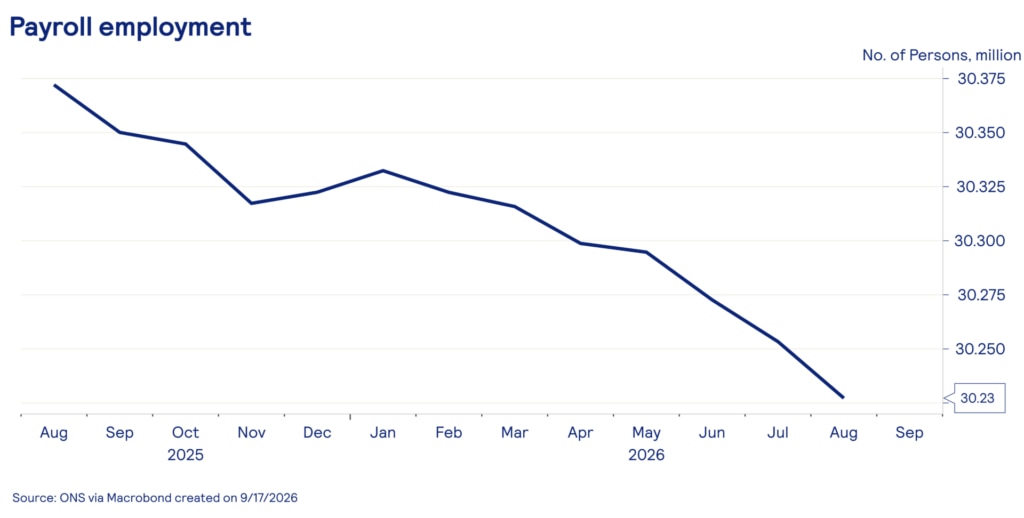
The second: the job losses mounting across the UK have little to do with AI. Another 26,000 payroll jobs were lost in August, bringing cumulative losses since early 2024 to around 220,000. But the sectors hit hardest – retail, hospitality, manufacturing – are precisely those with the least AI exposure.
With two trends pulling in opposite directions, where does that leave us with hiring right now? Let’s take a look.
GDP keeps growing with AI playing a bigger role than expected
The UK’s monthly GDP figures continue to come in hot. While monthly data always need to be taken with a pinch of salt, the direction of travel is clear: economic output is going up despite soaring energy costs as the Iran war continues.
Almost all of the growth is coming from services (specifically tech and professional business services) the two sectors where AI would be expected to have the greatest impact on productivity. The US is seeing something very similar. It is becoming increasingly clear that AI has started to affect growth at the macroeconomic level.
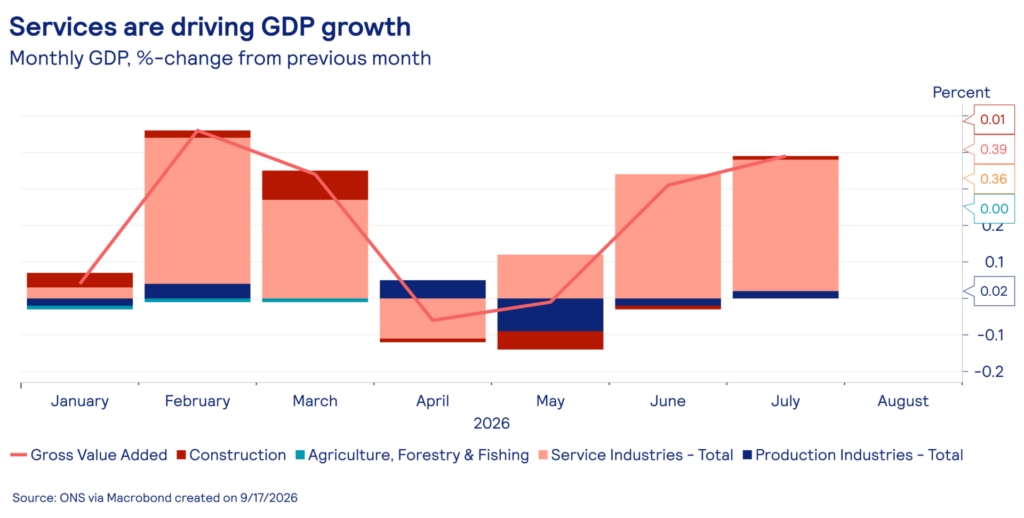
This is genuinely good news. It suggests the productivity improvement many economists hoped AI might eventually deliver is starting to show up in the data. The oil price shock will create some headwinds in the second half of the year. But 2026’s overall GDP figure now looks far more robust than almost anyone anticipated.
So the economy is growing strongly. The jobs market, however, hasn’t caught up.
Payroll employment continues to fall
Despite the positive growth numbers, payroll employment is still heading in the wrong direction. August saw a further 26,000 jobs lost (a provisional figure subject to revision) bringing cumulative losses since early 2024 to around 220,000.
It’s tempting to assume AI is behind the job losses, but the data suggests otherwise. The sectors shedding jobs most significantly are precisely those with the least AI exposure: wholesale and retail, accommodation and food services, and manufacturing. These sectors are bearing the brunt of subdued consumer spending (itself a knock-on of rising energy costs from the Iran war) alongside the cumulative impact of employer cost increases, including successive minimum wage uplifts and National Insurance rises.
Information and communication is the one notable exception: a higher-tech sector that has also contracted, losing tens of thousands of jobs since early 2024 as part of a global post-pandemic correction.
Healthcare, as ever, remains the standout bright spot – the one consistent source of job creation in an otherwise softening labour market.
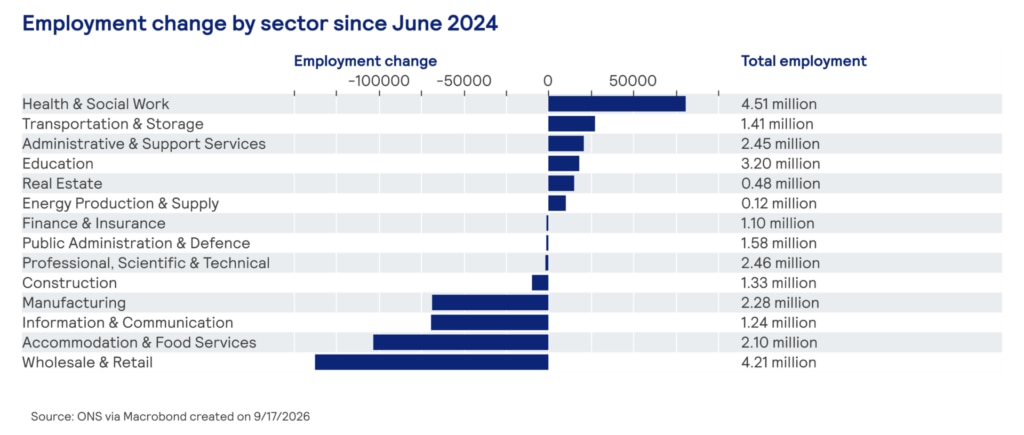
For recruiters, the sector picture is likely what matters most. Where jobs are being lost tells you where available talent is coming from. Where growth is concentrated tells you where competition for candidates is intensifying. Our Hiring Trends Update found that a third of UK recruiters (32%) cite finding candidates with the right skills as their primary hiring challenge – and that pressure is not distributed evenly across the jobs market.
Vacancies edge lower, but unemployment holds steady
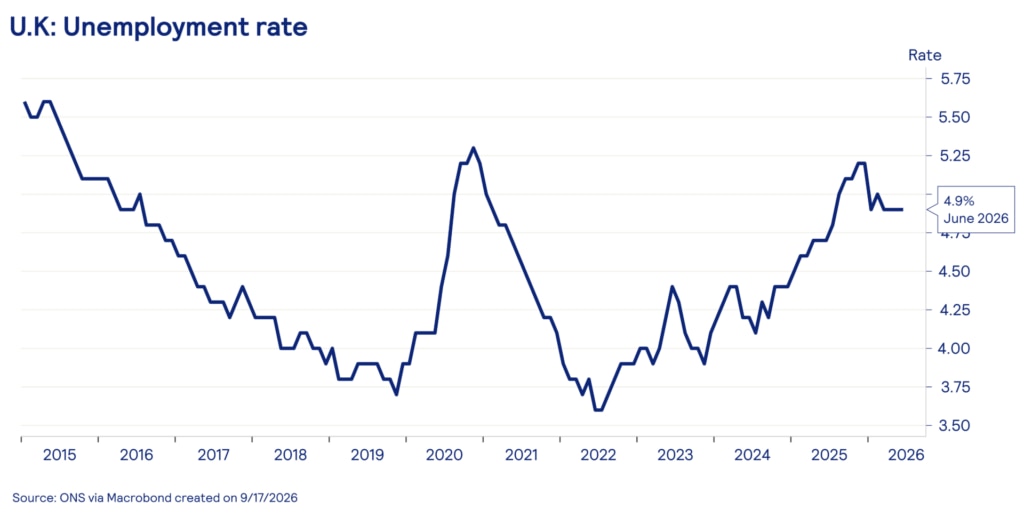
The unemployment rate remains at 4.9% for the May to July period: steady on the quarter, though up slightly on the year. It’s worth flagging that the ONS has acknowledged ongoing questions about the reliability of the Labour Force Survey methodology, with an update not expected until 2027. For now, payroll employment data is the more reliable real-time signal on where the labour market is actually headed.
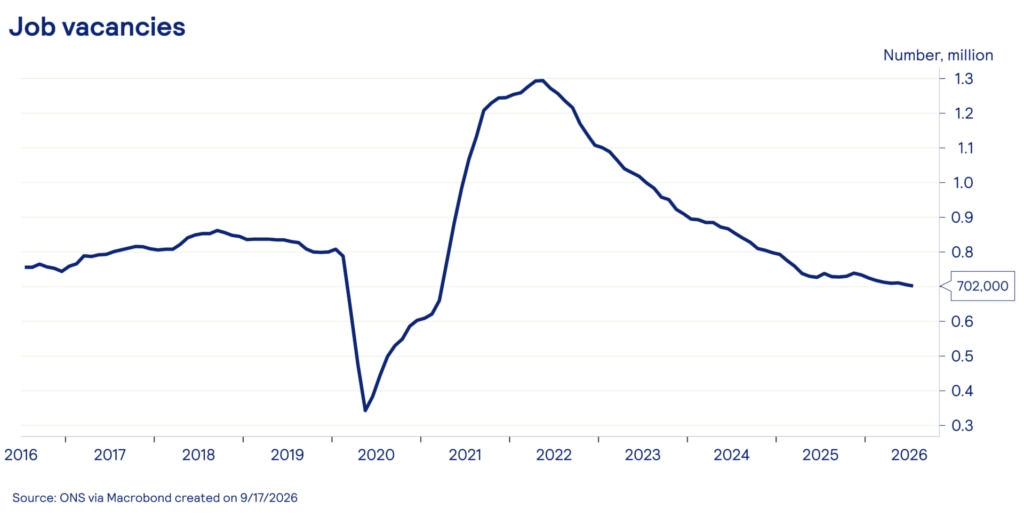
Vacancies have edged down further to 702,000 – the weakest level since 2014, outside of the pandemic. ONS feedback from its Vacancy Survey suggests smaller firms in particular are pulling back on recruitment in direct response to rising labour costs. Worker churn remains at a near standstill. Candidates are less able to move; employers are less inclined to hire.
That caution shows up clearly in our own research too. Only 18% of UK workers are actively looking for a new role right now, while 66% are passively open to the right opportunity. The talent pool is larger than the vacancy figures suggest, but reaching it takes more than posting a job and waiting.
The budget looms and the fiscal constraints are real
The October Budget will be closely watched. The Burnham government faces genuine pressure to address rising youth unemployment and broader labour market weakness. There is just one problem: the UK’s public debt burden is severe, with interest costs now exceeding £100 billion annually. That’s more than the entire defence budget, and well over half of annual NHS spending.
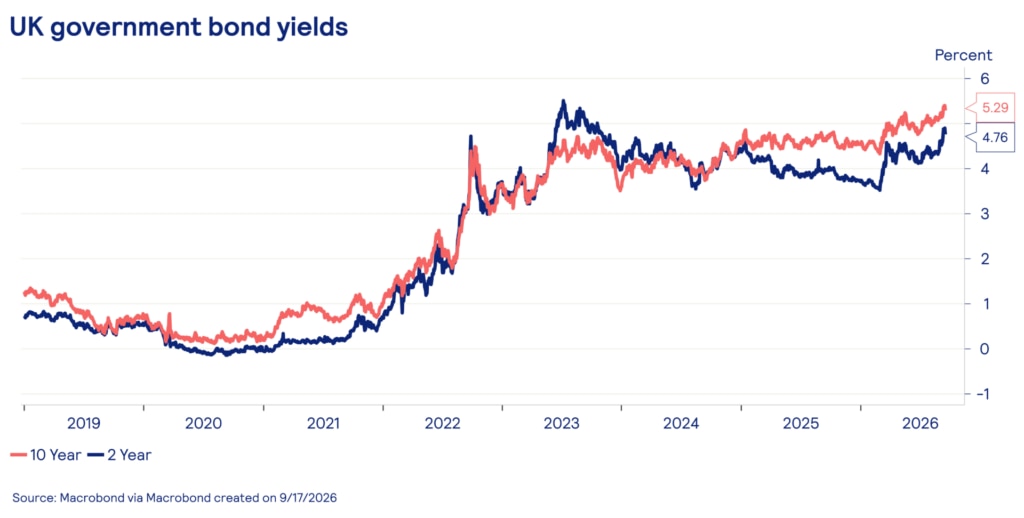
Policies that could help (infrastructure investment, reskilling programmes, targeted sector support) face real constraints given where the public finances sit. The Budget will clarify what’s actually on the table. For employers, the key question is whether October brings further cost increases or a period of stability that allows hiring confidence to rebuild.
What does this mean for recruiters?
The central story this month is a segmented labour market, and that matters more than the headline numbers suggest.
In many sectors, filling roles has become significantly easier than it was a year ago. Application volumes are high, candidates are available, and competitive pressure on employers has eased. Our Hiring Trends Update found that 45% of UK employers say hiring has become easier compared to a year ago, with 53% expecting volumes to increase over the next six months.
But that picture doesn’t hold everywhere. Workers with genuine AI skills remain in extremely short supply: demand is outpacing available talent, and compensation is rising sharply as a result. Blue-collar workers tied to infrastructure roles, particularly in data centre construction, are also in strong demand. In these pockets of the market, competition for candidates is as intense as it has been at any point in recent years.
For recruiters, this creates two very different challenges depending on where you’re hiring. In most sectors, the hard part is no longer sourcing applicants but filtering efficiently and identifying quality quickly from a larger pool. In AI and infrastructure roles, the challenge is more fundamental: the candidates you need are scarce, highly sought-after, and unlikely to respond to a standard job posting.
There are genuine grounds for cautious optimism. GDP growth is robust. Wage pressures are easing without a sharp rise in unemployment. And our own data shows that 53% of UK employers expect their hiring volumes to grow in the next six months – so the direction of travel, for most, is still forward.

Tip: before your next hire, work out which market you’re actually operating in. If you’re hiring in a sector with high candidate availability, the priority is speed and quality of screening – a slow or opaque process will cost you good candidates to employers who move faster. If you’re hiring for AI or infrastructure skills, a standard job posting is unlikely to cut it: proactive sourcing, strong employer brand communication, and transparent compensation will matter far more.
Analysis by Julius Probst, Senior Labour Market Economist, The Stepstone Group. Data: ONS Labour Market Overview, September 2026. Additional data: Totaljobs Hiring Trends Update Spring/Summer 2026 (n=885 UK employers); Totaljobs Salary Survey 2026 (n=2,950 UK workers). Watch Julius discuss this month’s data on Recruitonomics.
Explore articles





Receive the latest recruitment resources and
advice to boost your hiring
By providing us with your details you agree to our privacy policy and for us to keep you updated with the latest news, events,
and special offers from Totaljobs.