


20 employee incentive ideas to motivate and engage your teams in 2026
Table of Contents
- Key takeaways
- What are employee incentives?
- Benefits vs incentives
- Flexible work
- Financial
- Health and wellbeing
- Learning and development
- Recognition
- Empowering teams
- FAQs
UK Salary Trends Report 2026
Motivating employees requires more than competitive salaries and enticing benefits. Workers increasingly expect meaningful recognition and rewards for their contributions, expectations many employers are still struggling to meet.
UK Salary Trends Report 2026
With Gallup research suggesting 90% of workers are unhappy at work and our findings showing 41% plan to look for a new role, employers will increasingly need new ways to incentivise their workforce. In this article, we’re looking at 20 proven incentives you can integrate into your compensation strategy to motivate and engage employees in 2026.
Key takeaways
- Incentives play a crucial role in motivating employees beyond salary and standard benefits
- Financial incentives such as bonuses, commission and profit-sharing help reward high performance sustainably
- Wellbeing incentives, from mental health days to gym memberships, support healthier, more resilient teams
- Learning and development incentives help close skills gaps and strengthen long-term career progression
- Recognition-based incentives build a culture where effort is seen, valued and celebrated
- Tailored incentives are more effective than one-size-fits-all approaches
- Regularly reviewing incentive programmes keeps them aligned with evolving workforce expectations
What are employee incentives?
Employee incentives are tools used to motivate or encourage specific actions or behaviours.
In the workplace, they form part of a broader compensation strategy designed to inspire employees to perform at their very best.
Incentives can be financial or non-financial, but the goal is the same: to foster a motivated, engaged and productive workforce.
The importance of incentivising employees
Implementing effective employee incentives can deliver significant benefits for employers. This includes:
- Boosting productivity: Motivated employees tend to be happier and therefore more productive, with research showing happier workers achieve a 13% increase in productivity.
- Enhancing motivation: According to the World Metrics Report, 81% of employees feel more driven to work hard when their efforts are recognised and appreciated by their employer.
- Improving morale: Workplace morale can fluctuate, but a well-structured incentive programme helps maintain a positive environment, while celebrating wins and acknowledging effort builds a sense of shared purpose.
- Protecting wellbeing: Feeling undervalued can lead to burnout and disengagement. Incentives that support wellbeing, such as flexibility, mental health resources, or time off, help employees feel cared for and connected.
- Strengthening retention: With work-life balance currently the top career goal for workers (38%), incentives that support personal needs and professional growth can significantly reduce turnover and help employers retain top talent.
What is the difference between employee benefits and incentives?
While there is some overlap between employee benefits and incentives, the distinction is crucial when crafting an effective incentive plan. Keep in mind that benefits are baseline offerings available to all employees, regardless of performance. These typically include things like:
- Annual leave
- Flexible working arrangements
- Employer pension contributions
Incentives, on the other hand, are performance-based rewards, earned by meeting specific targets or goals. These are designed to acknowledge exceptional performance and encourage similar efforts in future.
With that in mind, below we’re going to look at the specific incentives you can offer to encourage employees to perform at a high level on a consistent basis, broken down into five distinct categories.
Flexible work incentives
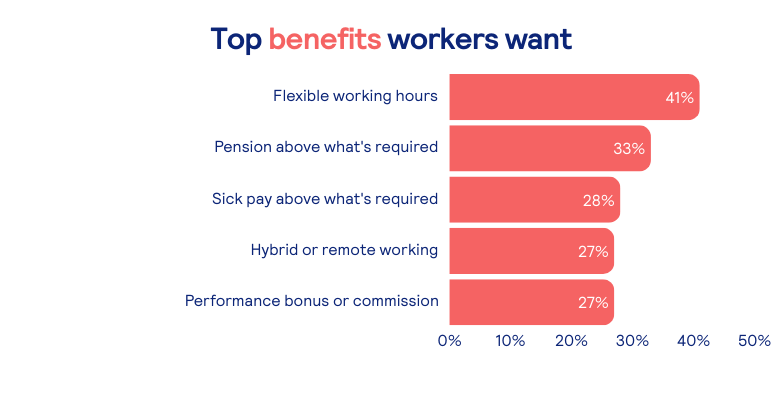
Flexible working has become a cornerstone of the modern workplace. With flexible working hours being the most desired benefit among UK workers (41%), it’s no surprise that flexibility-based incentives can significantly boost engagement and productivity.
The first set of employee incentive ideas we’re looking at revolve around flexible working.
Given the rise of both hybrid and remote working models in recent years, it should come as no surprise that a flexible approach to work is both a popular and proven way to increase happiness and productivity levels in staff.
1. Flexible working hours
It’s difficult to overstate how much of an incentive flexible working can be for today’s candidates. In fact, our latest research shows that flexible working hours are the most desired benefit among UK workers (41%).
Given this reality, wherever possible, employers should consider allowing employees to have a more flexible schedule that works around their personal lives, giving them a better work-life balance in the process.
Flexible working hours can make staff feel like they have more control over their time while also signalling that their employer trusts them to deliver.
2. Remote work stipends
In addition to flexibility around when they work, employees continue to also prioritise flexibility around where they work, with 51% saying hybrid or remote working would be a dealbreaker for them in their job search.
As a result, employers that are able to offer hybrid and/or remote work can further support and incentivise these workers with stipends for home-office equipment that creates a comfortable and productive workspace.
Offering this as an incentive demonstrates a commitment to employee wellbeing and helps remote teams to stay engaged and motivated.
3. “No-meeting” days
One of the biggest impediments to productivity within the modern workplace is often a calendar jam-packed full of meetings.
While well-intentioned, some of these meetings end up being timewasters that just eat into time that could otherwise be better spent focusing on high priority, high value tasks.
By implementing “no-meeting” days, employers can give their employees the space they need to be productive while helping to reduce stress and frustration.
4. Wellness breaks and mental health days
Ensuring that all team members have sufficient time off throughout the year to unwind and recharge is proven to reduce the risk of burnout across the workforce.
Given this, one potentially enticing incentive for modern employees that employers can include within their package are wellbeing days. For example, offering one or two of these each year.
Workers can use these to look after mental and physical health, helping them bring their best selves to work while demonstrating their employer’s commitment to their overall wellbeing.

Further reading
Championing mental health at work
Financial incentives
While employees love non-financial benefits, ultimately the biggest influence on someone choosing to apply for a job is the salary range on offer. Our research shows that 51% of workers looking to change roles are motivated by a higher salary.
The problem is salary benchmarking strategies may not allow for above-market salary packages. This is where financial incentives can come in, as these can help to keep performance levels high while boosting satisfaction and retention.
5. Performance-based bonuses
Depending on your industry and the type of roles you’re hiring for within your organisation, offering financial rewards for hitting specific performance milestones could be a viable option.
For example, milestones could include things like:
- Exceeding quarterly sales targets by 10% or more
- Completing major projects ahead of deadline and under budget
- Achieving consistently high customer satisfaction scores
- Securing new key accounts or partnerships worth £100K+
6. Profit sharing
Some organisations have seen remarkable success with the implementation of profit-sharing.
These schemes mean that staff get to benefit from the broader success of the organisation, giving them a feeling of ownership and belonging as well as a financial boost.
This can not only increase motivation and loyalty but also help to create a more unified workplace culture where everyone is pulling in the same direction.
7. Financial wellness programmes
Financial wellbeing is a growth area, with many UK workers becoming increasingly finance-savvy.
In our research from last year, we found that the top financial goals for workers over the next 10 years include:
- Saving for retirement
- Ensuring a comfortable standard of living
- Covering data-to-day living expenses comfortably
- Affording regular holidays or travel
As a result, equipping employees with the tools and skills they need to plan, budget and save can be a great incentive for many.
8. Commission-based rewards
A commission-based rewards structure is the original when it comes to employee incentive ideas. And for a good reason.
If your organisation has employees in sales or sales-adjacent roles, offering them commission in addition to their base salary can provide additional motivation for them to perform and succeed.
This is because their pay is, essentially, only limited by their own ability to hit and exceed their objectives by making sales that benefit the entire organisation.
Health and wellbeing incentives
We’ve already discussed mental health days as forming a crucial part of a wider employee benefits package, but there are a host of additional benefits related to health and wellness that employers should consider.
Let’s take a closer look at some of the most significant.
9. Gym memberships
Health and fitness have grown in importance and popularity among UK workers in recent years. As of 2024, 11.5 million people aged 16 and over belong to a gym in the UK, a record high and a rise of 1.6 million from 2022.
Employers can look to tap into this trend to incentivise their workforce while also improving morale and working to reduce absenteeism.
There are a variety of ways to do this, including:
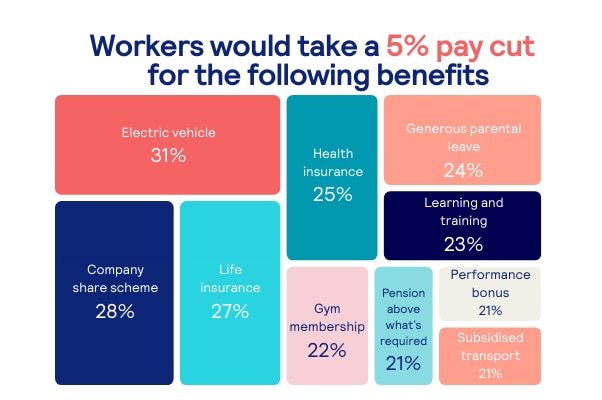
- Offering subsidised gym memberships
- Providing fully paid gym membership
- Giving employees access to fitness apps or wellness classes
10. Access to health apps or programmes
Shifting away from physical health to look at mental wellbeing, there are a whole host of useful health apps that offer daily wellness practices and guidance on things like meditation routines.
Employers can provide access to these for their workforce as an incentive. This can include discounts or free usage for apps like:
Providing employees with access to these or similar alternatives can reduce stress, helping to lower levels of burnout.
11. Mental health support
Rates of mental illness in the UK have been rising slowly and steadily since before the COVID-19 pandemic, an event that has only accelerated this trend.
As a result, many employers are now beginning to offer employee assistance programmes (EAP) to their workforce. These can give employees access to services like:
- Counselling
- Legal advice
- Family support
EAP’s are a worthwhile investment in many cases, with staff being given a valuable resource to improve their mental health and stay focused.
12. On-site or virtual health screenings
Another important and popular, yet sometimes overlooked, major health benefit that employers can offer to their workers are health screenings.
These can ensure employees can get ahead of any potential health issues and thereby take proactive steps to improve their overall wellbeing, thereby reducing absenteeism in the long-term.

Tip: To ensure accessibility, these health screenings can be conducted either virtually or in-person.
Learning and development incentives
Workplace opportunities for learning and development remain highly attractive to candidates. We found that 46% of workers won’t apply for a role that doesn’t come with support for professional growth and development.
As a result, the below benefits are popular with UK workers as they provide a clear route for career progression and a sense of development.
13. Paid professional courses
If your industry has opportunities for professional accreditation, then paying for your employees to go on courses (or offering tuition reimbursement) can help to improve their skills and progress in their career.
With so many organisations suffering from skills gaps, providing these types of incentives should be an easy decision when it comes to upskilling employees and encouraging professional development.
14. Mentorship and coaching
A powerful incentive that doesn’t cost anything is internal mentorship and coaching.
Getting senior staff to mentor more junior employees allows both the mentor and mentee to grow professionally. Furthermore, mentors will improve their coaching and leadership skills and can get a profound sense of satisfaction knowing they are helping the new generation.
Meanwhile, mentees can pick up knowledge gained from years of experience, which could help to propel their careers forward.

Guide to Effective Succession Planning
15. Lunch-and-learn programmes
Learn-and-learn sessions are informal sessions which, as the name suggests, are usually conducted during lunch breaks, and provide employees with opportunities to share their skills, knowledge and experiences to promote growth.
These programmes can help to encourage continuous learning in a collaborative environment, as well as build camaraderie amongst team members in a more relaxed workplace.
16. Career development sessions
Offering sessions dedicated to career development to employees as an incentive signals to prospective workers and current team members that you take their career seriously and you want to support them in achieving their goals.
These can be regular one-to-one meetings focused on short- and long-term career goals. These can also be tied in with mentoring, as mentioned above, but with more focus on specific career goals.
Recognition incentives
While the majority of UK workers are still driven primarily by salary and other financial incentives, old-fashioned workplace recognition still shouldn’t be overlooked.
Many workers want to know their efforts are appreciated by management, which means recognition initiatives can often end up being as powerful as financial ones.
17. Employees of the Month awards
Celebrating individual achievements through awards or public acknowledgement can build a culture of recognition that motivates staff to perform at their best.
You can also offer small rewards along with public recognition, such as:
- Restaurant vouchers
- Gift cards
The important part of this is the public recognition of a job well done and getting the whole organisation to join in the celebration.
18. Social and team-building outings
Social incentives are a very powerful tool for employers, as they can help build a culture of collaboration and teamwork which contributes towards a positive work environment.
Ideas for social team outings include:
- Monthly pub quiz nights and casual after-work socials
- Outdoor adventure days like climbing or kayaking
- Escape room challenges and problem-solving activities
- Seasonal celebrations and festive team dinners
19. Peer-to-peer recognition programmes
There are always new trends emerging when it comes to how workers want to be recognised. One of the latest comes in the form of allowing employees to give shout-outs to each other for the excellent work they are doing.
This is a powerful way to grow a culture of celebration within your organisation, as it encourages support and recognition to come from every level, not just management and senior leadership.
20. Year-end gift packages
Providing all employees with an end-of-year or seasonal gift can demonstrate your appreciation for their efforts over the course of the year. This can be especially effective in professions with a busy end of year period, like accounting, for example.
These rewards can, for example, come in the form of:
- Gift packages
- Holiday hampers
- Simple ‘thank you’ cards
Doing this can give staff a good feeling about their workplace as they head off for a few days of well-deserved rest before gearing up for the new year.
Empowering teams through strategic incentives
Incentivising employees means making a commitment to creating a motivated, engaged and loyal workforce. By working to incorporate both financial and non-financial rewards, employers can address the diverse needs of their teams, thereby helping to drive productivity, morale and overall satisfaction. Remember, successful incentive programmes are tailored to an organisation’s unique goals and the specific needs of its employees.
Get the insights you need to craft impactful employee incentives
UK Salary Trends Report 2026
Frequently asked questions (FAQs)
What’s the difference between benefits and incentives?
Benefits are baseline offerings for all employees, while incentives are performance-based rewards tied to specific behaviours or achievements.
How do I choose the right incentives for my workforce?
Start by gathering employee feedback, reviewing performance data and aligning incentives with organisational goals.
Do incentives always need to be financial?
No. Non-financial incentives, such as flexibility, recognition or development opportunities, can be equally powerful.
How often should incentive programmes be reviewed?
At least annually, or more frequently if your workforce or organisational priorities shift.
Are flexible working incentives still effective?
Yes. Flexibility remains one of the most valued workplace offerings and strongly influences engagement.
How can I measure whether incentives are working?
Track performance metrics, engagement scores, retention rates and employee feedback.
Should incentives differ for remote and on-site employees?
They can. Tailoring incentives ensures fairness and relevance across different working arrangements.
How do I ensure incentives don’t create unhealthy competition?
Use clear criteria, transparent processes and a mix of individual and team-based rewards.
Can small businesses offer meaningful incentives without big budgets?
Absolutely. Recognition, flexibility, development opportunities and peer-to-peer programmes are low-cost, high-impact options.
What’s the biggest mistake employers make with incentives?
Offering rewards without aligning them to behaviours, goals or employee needs, leading to low uptake and limited impact.
Explore articles





Receive the latest recruitment resources and
advice to boost your hiring
By providing us with your details you agree to our privacy policy and for us to keep you updated with the latest news, events,
and special offers from Totaljobs.