




Skills-first hiring and proactive workforce planning lead 2026 plans
Table of Contents
- Key takeaways
- Looking ahead to 2026
- Preparing for the year ahead
- The candidate perspective
- Staying ahead
- Your hiring solutions partner
- About the research
- FAQs
Hiring Trends 2026 Factsheet
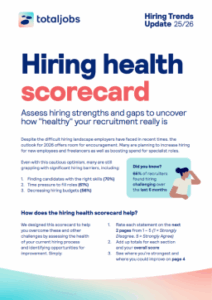
Hiring Health Scorecard
The second factsheet in the Totaljobs Hiring Trends Update series takes a deep dive into how employers, workers and jobseekers are preparing for 2026. Specifically, the findings examine the sentiment, priorities and trends that will shape hiring plans in 2026.
Hiring Trends 2026 Factsheet
Based on a survey of 900 HR leaders and 2,000 candidates across the UK, we’ve uncovered crucial insights to help employers and recruiters hone their 2026 hiring strategies and stay competitive in a fast-evolving labour market.
Hiring trends 2026: Key takeaways
- 58% of businesses are confident they will hire the talent they need in 2026
- 70% of recruiters say finding candidates with the right skills is a challenge
- Skills-based hiring (43%) is the top recruiter priority for next year, followed by focusing on soft skills (38%) and improving applicant quality (37%)
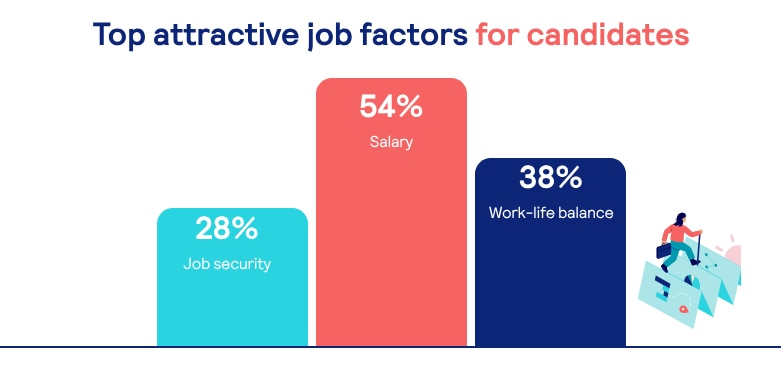
- 1 in 3 candidates plan to look for a new job in 2026 – with salary, work-life balance and job security in mind
- A decrease in hiring budgets (56%) is among the top challenges recruiters face
Looking ahead to 2026 after a period of adjustment
Although the general economic outlook remains mixed, with unemployment rising to 5% and payrolled jobs falling, there are signs that labour market conditions are beginning to stabilise.
The latest Autumn Budget announcement landed better than expected and provides employers with time to adjust their hiring plans before some changes come into play in April 2026 – with the most significant being an increase to the National Minimum Wage (rising from £12.21 to £12.71).

Cautious optimism emerging
Positively, our findings suggest that employers are cautiously optimistic – with 30% of large businesses planning to increase recruitment in the coming months (25% for SMEs) and many (31%) reviewing how their teams and structures are set up to meet future demand.
This cautiousness reflects the broader picture. Recent data shows a fall of 64,000 payrolled jobs in two months, alongside the weakest private sector pay growth since 2016 (outside of the pandemic). Employers are therefore planning increases in hiring from a position of careful assessment rather than rapid expansion.
Even so, confidence is slowly returning. More than half of businesses (58%) believe they will be able to secure the talent they need in the next six months. For recruiters, this marks a shift away from crisis management towards a more future-focused approach to growth.

Labour’s latest Budget lands with a mixed bag, but there are some reassuring signals for workers and employers. The Office for Budget Responsibility’s early numbers show the government has a bit more fiscal breathing room than expected, thanks to higher nominal earnings boosting tax receipts – even if growth itself isn’t racing ahead.
For businesses and jobseekers, that means the broader economic backdrop is more stable than last year.
Julius Probst, Labour Market Economist, The Stepstone Group
Preparing for the year ahead
With labour market data showing declining employment and weakening pay growth, employers will need to adapt to ensure hiring success in 2026. This will require paying close attention to trends like skills-based hiring, technology and transparency.
Sourcing relevant skills
Given 70% of recruiters say finding candidates with the right skills is a challenge, it should come as no surprise that the top priority for businesses in 2026 is skills-based hiring in 2026.
With recruiters on the hunt for candidates with soft (38%) and technical skills (37%), skills-based hiring looks set to be a pivotal trend next year, providing a way for employers to access diverse and untapped talent pools to plug skills gaps.
Get your free guide for hiring for the skills that matter most
Making the most of the latest technologies
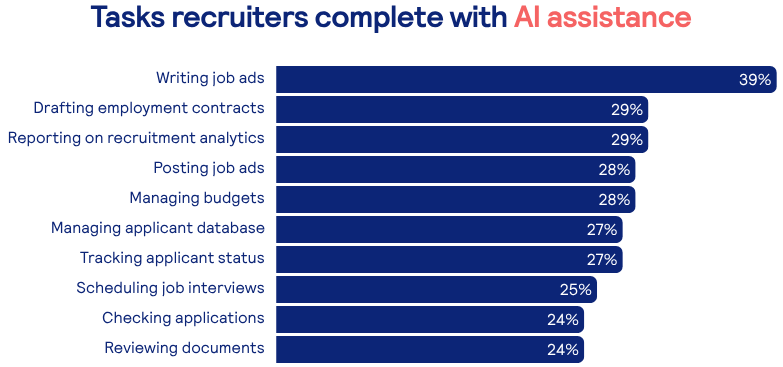
Numerous businesses are already using artificial intelligence (AI) in their recruitment processes to automate manual tasks. This includes things like:
- Job advert writing (39%)
- Posting adverts (29%)
- Managing budgets (28%)
Recruiters spend 11.7 hours on average a week on manual tasks, and 61% find time pressure to fill roles challenging, AI represents a crucial opportunity to free up capacity.
Utilising technology to automate manual tasks allows recruiters to focus on high-value tasks that require more time and effort, such as interviewing candidates and reviewing applications. This requires careful investment in tools that help recruiters better manage their workload and therefore work more efficiently.
Considering the implications of salary transparency
Salary transparency is increasingly on the agenda, with 1 in 3 (32%) employers making it a priority. This number rises even higher for certain industries, including manufacturing (40%) and IT & telecoms (48%)
Part of this may be driven by the upcoming EU Pay Transparency Directive. While this legislation does not directly apply to the UK post-Brexit, the directive is prompting UK policymakers to consider similar measures, including:
- Providing the specific salary or salary ranges on job adverts
- Not asking candidates their salary history
- Publishing or providing employees with information on pay, pay structures and criteria for progression
- Providing employees with information on their pay level and how their pay compares to those doing the same work or work of equal value
Moving forward, employers will need to keep up with the latest developments regarding salary transparency, both to ensure regulatory compliance and to remain competitive with EU employers who try to tempt talent with relocation, especially with salary (54%) remaining the main driver behind candidates’ decisions to take a new role.
The candidate perspective
When it comes to candidates, expectations are continually evolving. However, what is clear is that the overall hiring experience employers provide will be crucial to success in 2026.
We found that 86% of jobseekers are less likely to accept a role if their recruitment experience is poor, highlighting the vital importance of a smooth and efficient process. As a result, new technology like AI will be crucial moving forward, allowing employers to increase recruiter capacity, boost efficiency and improve the candidate experience.
Unsurprisingly, as many as 59% of candidates also believe that AI makes processes made applying more efficient.
At the same time, flexibility and fairness are becoming non-negotiables for jobseekers. Our research suggests that 72% of workers would consider leaving a job if it didn’t support flexible working, while 38% cite work-life balance as a key factor in their job hunt.
How to stay ahead of the competition
Knowing what’s coming is only the first step. The real challenge lies in turning these insights into practical action. Employers who move early to adapt their strategies will not only meet candidate expectations but also build an advantage in a competitive hiring landscape.
Let’s take a quick look at the initial steps employers and recruiters can take to effectively prepare for the year ahead.
Assess how your hiring stacks up with our free scorecard
Adopt a skills-based approach
Craft job descriptions based on core skills and competencies, use structured assessments, and equip hiring managers to evaluate candidates beyond CVs. This widens talent pools and helps ensure employees are placed in roles that suit their abilities, supporting both attraction and retention.
Improve the candidate experience
Streamline application and interview stages to reduce delays, provide faster feedback, and maintain clear communication. With almost 9 in 10 candidates less likely to accept an offer after a poor recruitment experience, efficiency and transparency are increasingly critical differentiators.
Free up recruiters time
With workload management ranking as a top employer priority, organisations can now use AI to handle repetitive tasks, freeing recruiters to focus on relationship-building and candidate engagement. Successfully balancing automation and personal interaction looks set to define successful hiring in the years and months ahead.
Double down on transparency and flexibility
Competitive pay, clear salary ranges, and flexible working arrangements are decisive for candidates. Delivering on these expectations will be essential to retaining talent and avoiding losses to competitors who can offer them.

Totaljobs – Your hiring solution partner
Work with an industry-leading hiring solutions provider that understands your challenges and can help you find the skilled talent you need.
Part of the global recruitment technology company, The Stepstone Group, Totaljobs is a cutting-edge recruitment solutions partner whose goal is to find the right job for everyone. Find the right people for your business by reaching wider talent pools, increasing your brand’s visibility, and maximising your hiring budget.
About the research
The Hiring Trends Update is a bi-annual piece of research that checks the current pulse of the recruitment market. We surveyed 900 HR professionals and 2,000 UK candidates between 3rd-5th of September. All responses were collected online and the candidate survey is representative of the UK population by gender and age.
Hiring Trends 2026 Factsheet
Frequently asked questions (FAQs)
What are the key hiring trends in 2026 that employers should prepare for?
The biggest hiring trends in 2026 include skills-based hiring, increased flexibility, salary transparency and greater use of AI in recruitment. Employers are prioritising soft skills (38%) to address talent shortages while flexible working and transparent pay are becoming crucial for attracting candidates.
Why is skills-based hiring becoming so important in 2026?
With 70% of recruiters struggling to find candidates with the right skills, skills-based hiring helps widen talent pools by focusing on competencies rather than traditional qualifications. This approach allows employers to fill skills gaps more effectively and improve both attraction and retention.
How confident are businesses about hiring success in 2026?
Despite economic challenges, 58% of businesses feel confident they will secure the talent they need in 2026. Larger organisations are particularly optimistic, with 30% planning to increase recruitment activity.
What economic factors are shaping hiring trends in 2026?
Rising unemployment, falling payrolled jobs and reduced hiring budgets are prompting employers to take a cautious approach. Many businesses are restructuring teams and investing more strategically rather than expanding rapidly.
How will AI impact hiring in 2026?
AI is expected to play a major role in recruitment, especially in automating tasks such as job advert writing, posting roles and managing budgets. With recruiters spending an average of 11.7 hours per week on manual work, automation frees up time for interviewing, candidate engagement and strategic decision-making.
What are candidates prioritising when job searching in 2026?
Candidates are mainly motivated by salary, work-life balance and job security. Flexibility is essential, with 72% of workers willing to leave a job that doesn’t support flexible working.
Explore articles




Receive the latest recruitment resources and
advice to boost your hiring
By providing us with your details you agree to our privacy policy and for us to keep you updated with the latest news, events,
and special offers from Totaljobs.